1. We now continue to build and finish our basic framework for a biblical ordu salutis. With Romans 8:28-30 as the scaffolding, we have built the following arrangement: calling, regeneration, faith and repentance, justification, definitive sanctification, adoption, glorification.
2. We will conclude our ordu salutis with sanctification. When we consider glorification we will consider other events that are involved such as death and resurrection. After we place sanctification in the ordu salutis, we will look at a couple of diagrams to see an overall picture of God's saving grace to us in Christ Jesus.
A. The Relationship Between Faith and Progressive Perseverance in Sanctification
1. The blessings of salvation affect changes in and for the sinner in two essential ways:
i. Salvation effects a change in the sinner himself.
ii. Salvation effects a change of the sinner's status, or standing before God; a change in the sinner's
relationship to God.
2. The change of the sinner's condition (caused by the effectual call and regeneration) results in the sinner's conversion (faith and repentance), which is the definitive change in a man's experience in which he is aware of turning from his sin and turning to Jesus to become His disciple. When he repents and believes in Jesus, there is a change in his status, his position, his relationship to God (justified, definitively sanctified, and adopted).
3. These blessings form the foundation of the Christian life. These blessings continue to inform our understanding and experience of our ongoing communion with God.
i. We are born again only once; converted only once; justified, definitively sanctified and adopted
only once. These are foundational blessings. But we need to continually build upon the
foundation and to experience their benefits.
ii. We continue to believe, to repent. Although we are converted only once, we continually rehearse
the gospel and the essentials of our conversion as we grow in sanctification, putting off old man
and putting on Christ; confessing and repenting while believing in Jesus and exercising the
privileges of being justified and adopted. These are the realities in which we are to grow and
mature as we live our new life in Christ which continues until we are glorified.
4. Sanctification and perseverance are blessings which are the result of regeneration. The believer, now alive in Christ, grows and progressively continues in the transformation, not of his relationship to God, but of himself as a sinner to a glorified saint of God.
5. We've seen that in regeneration there is a "definitive sanctification." We are set apart from sin and the world, and placed in a holy relationship to God. We are set apart for God's glory. Regeneration effects a cleansing as well as imparting life. The life that we are given in regeneration is a holy life. It is the life of the Holy Spirit.
6. We then live the Christian life as we are progressively, continually growing in holiness. We mature as sons of God who grow to become more like Jesus. We grow as we continually exercise faith and repentance, as we persevere in the spiritual warfare with the sin that remains within us and with the temptations to sin that press on us from Satan and this fallen world. We grow in sanctification as we learn obedience to Jesus and cultivate a live of good works.
i. 2 Pt 3:18 but grow in the grace and knowledge of our Lord and Savior Jesus Christ. To Him be
the glory, both now and to the day of eternity. Amen.
ii. Phil 3:13,14 Brethren, I do not regard myself as having laid hold of it yet; but one thing I do:
forgetting what lies behind and reaching forward to what lies ahead, I press on toward the goal
for the prize of the upward call of God in Christ Jesus.
iii. Eph 2:8-10 For by grace you have been saved through faith; and that not of yourselves, it is the
gift of God; not as a result of works, that no one should boast. For we are His workmanship,
created in Christ Jesus for good works, which God prepared beforehand, that we should walk in
them.
iv. Tit 2:11-14 For the grace of God has appeared, bringing salvation to all men, instructing us to
deny ungodliness and worldly desires and to live sensibly, righteously and godly in the present
age, looking for the blessed hope and the appearing of the glory of our great God and Savior,
Christ Jesus; who gave Himself for us, that He might redeem us from every lawless deed and
purify for Himself a people for His own possession, zealous for good deeds.
7. We will learn that we are called to live the Christian life by faith. We must never give up, but we must endure to the end, we must persevere. But our perseverance, our life of faith, is the result of God's grace working within us. God preserves us. He keeps us, protects us, and enables us to endure to the end and finally to be glorified in the resurrection and the new heaven and earth of the age to come.
8. So we have constructed this ordu salutis: calling and regeneration, faith and repentance, justification and adoption, sanctification and perseverance (and preservation), and finally, glorification.
9. Berkhof offers this summarization, p.418: "The great majority of Reformed theologians... begin the ordo salutis with regeneration or with calling, and thus emphasize the fact that the application of the redemptive work of Christ is in its incipiency a work of God. This is followed by a discussion of conversion, in which the work of regeneration penetrates to the conscious life of the sinner, and he turns from self, the world, and Satan, to God. Conversion includes repentance and faith, but because of its great importance the latter is generally treated separately. The discussion of faith naturally leads to that of justification, inasmuch as this is mediated to us by faith. And because justification places man in a new relation to God, which carries with it the gift of the Spirit of adoption, and which obliges man to a new obedience and also enables him to do the will of God from the heart, the work of sanctification next comes into consideration. Finally, the order of salvation is concluded with the doctrine of the perseverance of the saints and their final glorification."
10. Reymond, p.712: "The application of salvation, purchased in its entirety by Christ's redemptive activity, commences with God the Father's irresistible summons to the spiritually dead elect sinner, normally issued in and by the proclamation of the gospel, to enter into fellowship with Jesus Christ. The Spirit of Christ, working by and with that summons, regenerates the spiritually dead elect sinner, enabling him thereby to repent of his sins and in faith to receive and to rest upon Christ alone for salvation, in which activity he is united to Jesus Christ. The moment he believes in Christ, God forgives him of all his sins and declares him righteous in His sight, definitively sanctifies him, adopts him into His family and seals him to the day of redemption with the indwelling Spirit of adoption. The sinner, now a Christian, begins to experience the lifelong process of progressive sanctification, throughout which time he also perseveres in holiness by the power of the Holy Spirit, with the end and goal of this entire series of acts and processes being his glorification, into which state he is finally brought in the Eschaton at the return of Christ. At that point he will be fully conformed to the image of the Son of God, his summum bonum, and Christ will then be in the highest sense possible 'the Firstborn among many brethren.'"
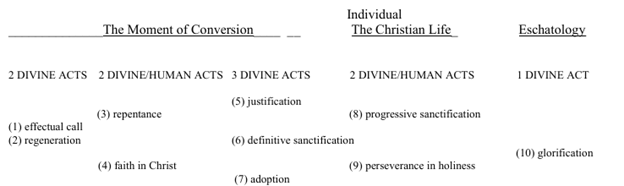
11. The following is Reymond's schema (p.711) of ten soteric blessing which I've categorized under three headings:
B. Supralapsarianism and Infralapsarianism
1. Theologians ask the question, "When did God decree or chose His elect? Before the fall [Supralapsarian] or after the fall [infralapsarian.]?" There are a lot of interesting aspects to the discussion in which these questions are answered. We will not delve into that discussion. Let me point out that those are bad questions because God's will, like God, is eternal and unchanging. To ask "When" of God is treat God as though He were a creature, subject to time. God transcends time and is eternally present His name is YHWH (Exo 3:14) - I AM.
2. What is my answer to the question? Both. God is supralapsarian, forming of His purpose to save and electing us in eternity past in Christ Jesus before the foundation of the world. But God implements His purpose in creation through time and in the sequence of history, His plan to save was not implemented until after the Fall - Gen 3:15. We see an infralapsarian salvation.
3. Bavinck (p.371-372) offers the following illustration of the unity of the decree(s) of God; "just as a genius suddenly and completely grasps the idea of a work of art, in like manner throughout all eternity the idea of the universe is fully and completely present in the divine self-consciousness. But just as in the case of an artist the execution of his conception must needs be gradual, in like manner there is a temporal and piecemeal visible unfolding of the one and only, all-comprehensive divine decree. The idea of the universe is single, but when it is realized [historically actualized], it unfolds itself in all the riches of its beauty in the forms of space and time... in like manner the one and only eternal decree of God is gradually and little by little unfolded before the eye of the creature, unfurling itself in many events and happenings, each of which in turn points back to a definite moment in the single decree of God..."
4. To use Bavinck's illustration, the Father, like an artist, determines that He will produce a work which will glorify His Son. He first envisions the work in its completion. It will be a portrait; painted with acrylics; on a three foot by four foot canvass. The artist then gets the raw materials for project. In his plan, he works from the idea of the finished product to the processes to be employed and then to the material to be used. But when he actually implements his plan, he begins with the raw materials, employs the intended processes and ultimately arrives at what was the first aspect of the plan: the goal - a painted portrait. The intended goal of glorifying the Son (supra) drives the historical (infra) unfolding of the decrees. History moves by the necessity of God's purpose to glorify Christ.
i. Use the diagram of infra and supra ii. Also Diagrams of William Perkins and John Bunyan on ordo salutis. Perkins is supralapsarian and Christocentric whereas Bunyan is infralapsarian and locates the blessings of salvation more inside the believer than in union with Jesus. Both are helpful, but Perkins is to be commended.
A DIAGRAM OF THE APPLICATION OF REDEMPTION
ALL "IN CHRIST"
GOD ACTS IN ETERNITY PAST
Decree of Election
(According to His good pleasure and foreknowledge)
GOD ACTS IN TIME
(Objective Soteriology: Historia Salutis)
Sends His Son to Accomplish Redemption
Sends His Spirit to Apply Redemption
(Subjective Soteriology: Ordo Salutis)
Effectual Call & Regeneration
(Gospel summons to Repent and Believe
Effecting, by the Holy Spirit, the New Birth of the Elect)
MAN ACTS IN TIME
(Now regenerated and enabled by Grace)
Conversion: Faith & Repentance
GOD ACTS IN TIME
Change in Relationship with God
(Gift of the Holy Spirit - Definitive Sanctification: Sealed)
1. Justification - Judicial - criminal court: legal
2. Definitive Sanctification - temple court: priestly
3. Adoption - Filial - civil court: domestic
GOD AND MAN ACT IN TIME
Change in the Sinner Himself (Stemming from Regeneration)
1. Progressive Sanctification
2. Perseverance/Preservation
GOD ACTS IN TIME
Culminated Sanctification: Glorification (Resurrection)